
Effect of Tensile Load and Temperature on Bituminous Geomembrane Seams

EuroGeo 8, Lille, France
Publication by Eric Blond, Jean-Pierre Giroud, and John Scheirs

Abstract
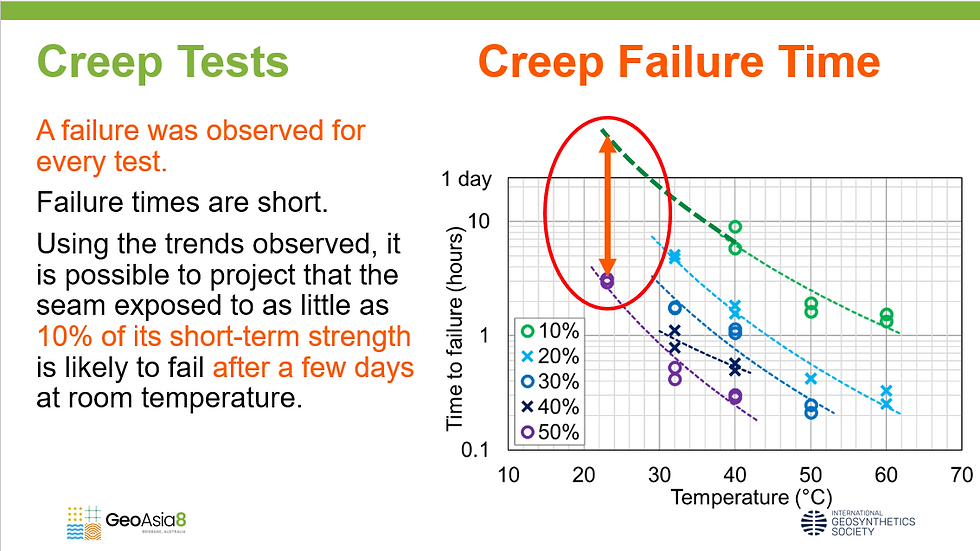
Geomembranes, and their seams, are exposed in the field to tensile loads and elevated temperatures. The tensile-shear strength of bituminous geomembrane seams was assessed through laboratory testing under temperatures ranging between 23 and 80°C. Constant-load (creep) tests were conducted under temperatures ranging between 23 and 60°C to measure the seam separation rate and failure time as a function of temperature. The results show that both the short-term tensile-shear strength of bituminous geomembrane seams and the seam separation rate under constant loading are a function of temperature. A theoretical analysis of the creep tests shows that the behavior of the seams is consistent with published data on the viscosity of bitumen. A practical consequence of the tests is that, unless the tensile loads exerted on a bituminous geomembrane seam dissipate (which may happen in the field under certain conditions), the relative displacement of the two seamed geomembrane sheets is likely to continue at a rate depending on tensile load and temperature, until full separation of the seam. The data provided in the paper are expected to have an impact on the way bituminous geomembrane seams are evaluated and the way bituminous geomembranes can be safely used in containment facilities.


Comments